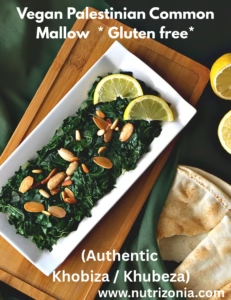
An easy-to-make common mallow green side dish to go with any meal! It has a unique, earthy flavor elevated with a splash of tangy fresh lemon juice. Packed with nutrients, this traditional Palestinian side dish is naturally vegan, dairy-free, and gluten-free too.


Disclaimer: We are at Nutrizonia a participant in the Amazon Services LLC Associates Program, an affiliate advertising program designed to provide a means for sites to earn advertising fees by advertising and linking to Amazon.com . We earn a small percentage, when you click and order items here in the post, or other items (same cost for YOU, no EXTRA fess needed)
Here is another special recipe from our Arabic Cuisine series—a traditional dish that many families sadly don’t cook as often anymore. However, people who love keeping traditions alive—like my mom, who loves and misses her home country of Palestine—still cook these cherished dishes like Khobiza.
I never had it when I was young (you know how kids can be with “too green” dishes or meals without meat!). However, as an adult, I love trying new dishes and I am so happy to document and preserve my Palestinian heritage through these traditional recipes.
🍃 What is Common Mallow (Khobiza)?


Common Mallow is a wild leafy green plant that grows abundantly across the Mediterranean region (including Palestine, Italy, and North Africa). Surprisingly, even in the U.S. and North America, you can find local common mallow growing wild!
It goes by several common and botanical names, such as Cheese Mallow, Cheeseweed, Malva neglecta, and Malva parviflora.
Both the tender leaves and stems are completely edible—you can enjoy them raw in salads or cooked. Taste-wise, common mallow tastes somewhat like kale or Swiss chard, with a silky texture similar to Mloukhiya (Jews Mallow). Because of its tender nature, it makes a fantastic quick sauté or a comforting wild green stew!
🌿 Why Common Mallow Is Great for You (Nutritional Perks)
Common mallow is packed with nutrients just like other dark leafy greens—it is literally a free, wild superfood! In Palestine, it was historically gathered straight from backyards and country roadsides, cooked simply with quality extra virgin olive oil to create a deeply fulfilling meal.
Here is what science says about this humble wild green:
-
-
Rich in Essential Vitamins & Minerals: High in Vitamin A (for vision and immunity), Vitamin C (for skin and cellular health), B-complex vitamins, and folate.
-
Soothing Natural Mucilage: Mallow leaves naturally contain plant mucilage (soluble soothing fibers). Leaf extracts are traditionally used in cough syrups and herbal remedies to soothe irritated throats, coughs, and digestive linings.
-
Antioxidant & Anti-Inflammatory Properties: Research published in PubMed shows that common mallow leaf extract exhibits significant anti-inflammatory and antioxidant activity, which helps reduce oxidative stress and manage inflammatory conditions.
-
Topical Soothing Power: Poultices made from crushed mallow leaves have long been used in traditional folk medicine to calm insect bites, mild burns, and skin irritations.
-
💡 Variations & Substitutions
-
-
Cannot Find Fresh Mallow? Substitute with baby spinach, Swiss chard, dandelion greens, or fresh/frozen Mloukhiya (Jews Mallow) leaves. Sauté them using the exact same olive oil, onion, and lemon method!
-
Garlic & Mushroom Twist: While traditional Palestinian Khobiza relies strictly on sautéed onions, olive oil, and lemon, you can make a modern fusion variation by adding minced garlic, sliced mushrooms, and a splash of low-sodium soy sauce or tamari.
-
Serving Pairing: Pair this sautéed Khobiza with a warm bowl of traditional Middle Eastern Red Lentil Soup and warm flatbread for a nourishing, high-protein plant-based dinner.
-
Pin it, save it for later!


************************
❓ Frequently Asked Questions (FAQs)
1. What is Khobiza (Khubeza) in English?
Khobiza (also spelled Khubeza or Khobeza / خبيزة) is the Arabic name for Common Mallow (Malva neglecta or Malva parviflora). It is a wild, nutrient-dense green leafy plant that grows naturally across the Mediterranean region and North America.
2. What does common mallow taste like?
Common mallow has a mild, earthy, slightly sweet flavor similar to kale, spinach, or Swiss chard, with a delicate, silky texture when sautéed in extra virgin olive oil.
3. Can I use spinach or Swiss chard if I cannot find Khobiza?
Yes! If fresh common mallow is unavailable in your area, you can easily substitute baby spinach, Swiss chard, or Mloukhiya (Jews Mallow) leaves using the exact same cooking technique with onions, olive oil, and fresh lemon juice.
4. Is Khobiza healthy?
Extremely! Khobiza is a wild superfood packed with vitamins A, C, and B-complex, folate, antioxidants, and natural soothing mucilage that supports digestive and respiratory health.
🛒 Shop the Recipe
Here are a few kitchen staples to bring out the authentic flavors of this traditional Palestinian dish:
-
Authentic Palestinian Extra Virgin Olive Oil: The heart of this dish! High-quality cold-pressed olive oil brings out the richness of the greens.
-
Heavy-Bottomed Stainless Steel Skillet: Excellent for gently wilting leafy greens evenly without scorching.
-
Manual Citrus Squeezer: Effortlessly extracts every drop of fresh lemon juice over the cooked greens.

Palestinian Sauteed Common Mallow (Khobiza)
Learn how to make authentic Palestinian Khobiza (sauteed common mallow leaves) with olive oil, onions, and lemon. A healthy, vegan Middle Eastern superfood.
Ingredients
- 2 cups fresh common mallow leaves (Khobiza), washed and roughly chopped
- 1/2 Tbsp extra virgin olive oil (preferably high-quality Palestinian olive oil)
- 1 small yellow onion, thinly sliced into half-moons
- Pinch of sea salt and freshly cracked black pepper
- 1/2 fresh lemon (for squeezing over top)
Instructions
- Sauté Onions: Heat a skillet over medium heat and add the extra virgin olive oil. Add the sliced onions and sauté for 2 to 3 minutes until soft and translucent.
- Wilt the Greens: Add the roughly chopped common mallow leaves to the skillet. Gently toss the leaves with the onions, seasoning with a pinch of sea salt and black pepper. Sauté for just 2 to 3 minutes until the greens are tender and wilted.
- Finish & Serve: Squeeze fresh lemon juice over the top, stir gently, and serve hot immediately with warm flatbread or pita!
Notes
Nutrition Information:
Serving Size:
1Amount Per Serving: Calories: 860Total Fat: 4gSaturated Fat: 1gUnsaturated Fat: 4gSodium: 201mgCarbohydrates: 211gFiber: 2gSugar: 145gProtein: 5g
📌 Related Recipes from the Arabic Cuisine Series
-
Authentic Middle Eastern Red Lentil Soup – The ultimate cozy, high-protein pairing for sautéed greens.
-
Creamy Mutabal (Palestinian Eggplant Dip) – Smoky roasted eggplant mezze with tahini and lemon.
-
Vegan Stuffed Grape Leaves (Yalanji) – Tangy grape leaves stuffed with whole-grain bulgur and herbs.
Have you ever tried common mallow or Khobiza before? I’d love to know how you cook it or if it grows wild in your region—let me know in the comments below!


Greetings, I’m living in Abu Dhabi. Where can I find fresh common mallow to buy?
Thank you, Dinko.
Hi Dinko, it’s a bit hard to find it, however, you need to look in the central vegetable market, or in shops that sells Palestinian/Jordanian products in Abu Dhabi.
I just tried this for the first time, foraged the mallow in my neighborhood here in San Diego, California, US. SO delicious! I did add a bit of garlic, because I just love garlic with greens.
oh it looks fantastic, I bet garlic tastes great with it, so glad you enjoyed it 🙂
Is this the same as, or equivalent to, the common city week called Cheeses? If so, I could gather it in season and eat it. I already eat chenopodium album, most commonly called lamb’s quarters, also called wild spinach.
Well, I believe it’s not the same. however, I see no objects to try this recipe. let me know if you make it!
We eat mallow in kashmir and we make it with lots of garlic, pinch of turmeric, red chilli powder, salt and slit green chilies…. it’s so good
lovely how different cultures are more similar than different, thanks for passing by, enjoy mallow!